
FIRST WAVES · SURF KNOWLEDGE · ABOUT 8 MINUTES
Your First Surf Day: What to Expect from Your Lesson

AI-generated placeholder photo
A surfboard under your arm, sand beneath your feet and the sea in front of you. Your first surf day is here. You might be excited. Maybe a little nervous too. Both are part of it.
You don't need to be particularly sporty or know how to stand on a surfboard. That's what your first lesson is for: learning the basics, getting familiar with the sea and trying your first waves.
And don't worry: you don't have to stand on the board for your first surf day to be a success.
In this article
What happens in your first surf lesson?
A beginner lesson usually starts with an introduction on the beach. You get to know your board, practise key movements on land, then enter the water with your surf coach.
How much time you spend in the water depends on the lesson and conditions.
1. Get to know your board and understand the sea
For your first attempts, you will often use a softboard. Its softer surface, size and volume help make learning easier.
Your coach shows you how to handle the board safely. Together, you also look at the sea:
- Where are the waves breaking?
- Which area is suitable for practice?
- Are there currents or other hazards?
- How do you keep your distance from other surfers?
Learning to surf is about more than standing on a board. You also learn to understand the sea better.
2. Practise your first movements on the sand
Before you catch your first wave, you try the basic movements on land.
You learn how to lie centrally on the board, paddle and move from lying to standing. This pop-up movement is called the Take-off.
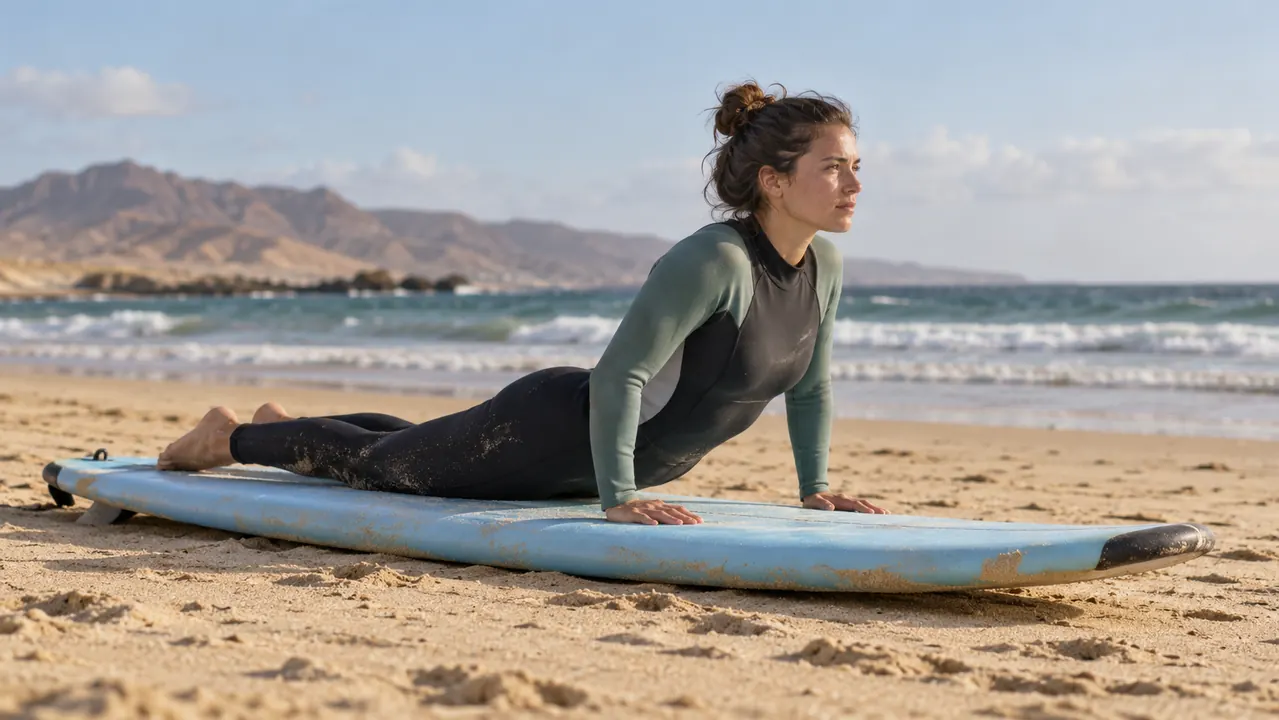
With the take-off, you practise moving from lying to standing with control, initially without any waves.
AI-generated placeholder photo
It's not about jumping up as quickly as possible. Understanding the movement and performing it with control matter much more.
Your first take-off tip: as you stand up, look where you want to go rather than at your feet. Your gaze helps you align your body and keep your balance.
3. Into the water: your first waves
Now comes the exciting part.
Depending on conditions, you enter a suitable practice area. Beginners often start in whitewater: the foamy water of a wave that has already broken.
Here, you get your first sense of a wave pushing your board.
You may first glide along on your stomach. You might even manage your first take-off. And you will probably fall into the water a few times too.
All completely normal.
Your first goal isn't perfect surfing. It's getting to know your board, the waves and your movements better.
4. Try, get feedback and keep learning
Not every attempt will work. Your board's nose may dip underwater, or you may lose your balance while standing up.
That's exactly what your surf coach is there for.
You receive feedback and can make a specific change on the next attempt.
A tip: focus on just one thing at a time. Thinking about your feet, arms, gaze and posture all at once quickly gets complicated.
One small improvement per wave is plenty.
Feel free to ask questions. If you need an exercise explained again, feel unsure or need a break, say so.
You don't have to prove anything on your first day.
What you need for your first surf day
You usually don't need to buy your own surf equipment. Many beginner lessons provide a board and, where needed, a wetsuit. Ask beforehand what is included.
Your packing list for your first surf lesson
- Swimwear for under your wetsuit or for surfing
- Towel and dry clothes
- Water-resistant sun protection
- Drinking water
- A small snack for afterwards
- A little patience with yourself
Do I need to be sporty for my first surf lesson?
You don't need any particular fitness level or any previous board-sport experience.
Surfing can be physically demanding, though. Paddling, standing up and moving in the water use muscles you may use less in everyday life.
Take breaks when you need them.
Important: you should be able to swim. If you feel unsure in the water or have a health condition, discuss it before the lesson so you can check whether taking part is suitable for you.
Surf safely: key rules for beginners
Don't underestimate even small waves. A few simple rules can help you avoid many risks:
- Stay in the practice area. Your coach shows you where you can practise more safely in the current conditions.
- Keep your distance. Even a soft beginner board can injure other people.
- Protect your head when you fall. Try to fall to the side, away from your board, and never dive headfirst into unfamiliar water. Protect your head when resurfacing too.
- Don't hold your board in front of your body when a wave comes. It could push the board into you.
- Listen to your coach, especially if waves or currents change.
If you are exhausted or feel uncomfortable, tell your coach and take a break.
Safety is as much a part of surfing as enjoying the waves.
What if you don't stand up on your first surf day?
You still had your first surf day.
You may have learned to balance your board better. You may have felt a wave pushing you for the first time. Or you now know what to focus on in your next take-off.
That is real progress.
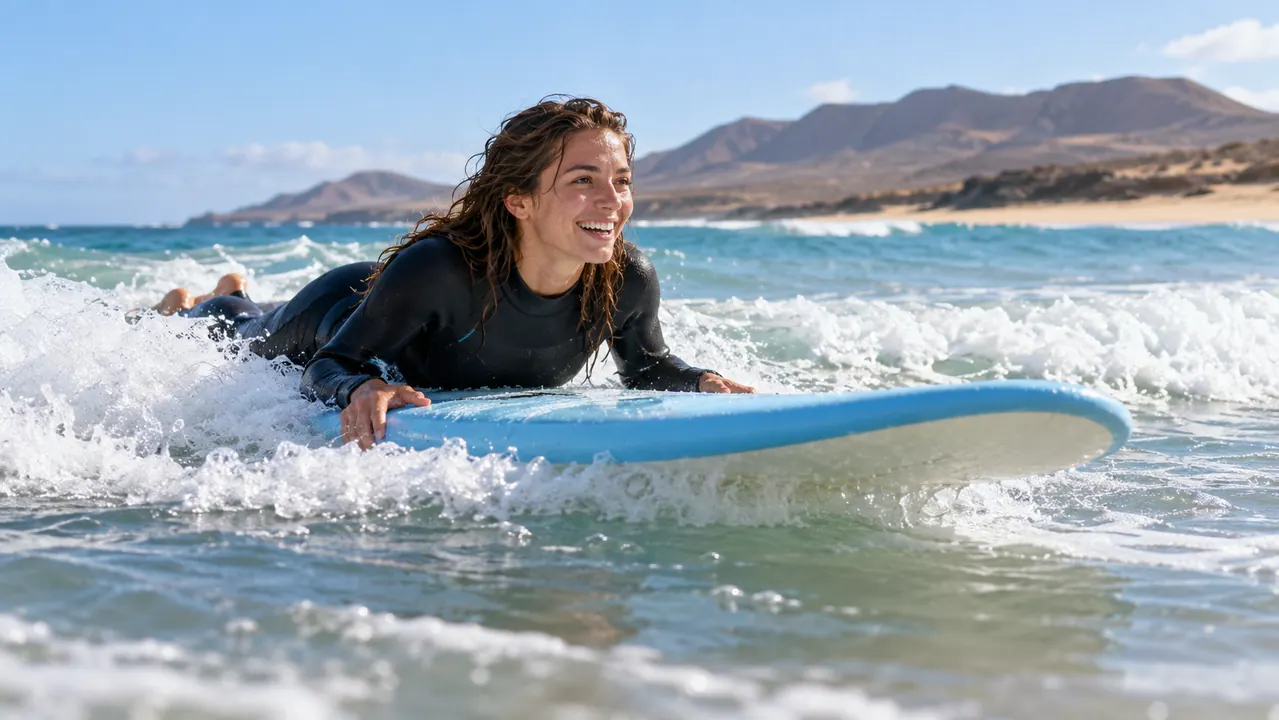
Catching a wave while lying down is a success too. You feel the wave pushing your board for the first time.
AI-generated placeholder photo
Some people stand up in their first lesson. Others need several sessions. Both are absolutely fine.
Don't compare yourself with others in the lesson. Everyone learns at their own pace.
And that first short glide across the water can feel great even when you're lying down.
Frequently asked questions about your first surf day
How long does the first surf lesson last?
That depends on the provider and lesson you book. A surf lesson usually includes an introduction on the beach, exercises on land and practice in the water. Ask beforehand about the total duration and planned water time.
Can I stand on the board in my first lesson?
Yes, it's possible. Some beginners manage their first take-off in the first lesson; others need several sessions. What matters is developing a feel for the board and waves.
Do I need good fitness for my first surf lesson?
No particular fitness level is required. However, surfing is physically demanding. You should be able to swim and tell your coach if you need a break or feel unsure in the water.
What if I'm afraid of the waves?
Talk to your coach about it. You can ask for exercises to be explained again, skip a wave or take a break. You don't have to force anything.
Can I take a lesson without any surf experience?
Yes. Beginner lessons are designed for exactly that. You learn how to handle your board, the basic movements and key safety rules from the start.
Your first surf day can simply be the beginning
You may finish your first lesson standing on the board. Or you may glide through the whitewater on your stomach and return to the beach with a big grin.
Both can feel pretty good.
Surfing takes practice, patience and sometimes a few unplanned falls into the water.
Your first surf day doesn't have to be perfect.
And who knows: that first brief glide might already have you looking forward to the next wave.
Your first waves. At your own pace.
Would you like personal guidance on your first surf day? Tell Julian when you will be in Fuerteventura and what you hope for from your first session. Together, you will work out which coaching suits you.